

Preparing for the digital future of energy

With an overwhelming emphasis towards smarter and more eco-friendly methods of power generation and distribution, the future of the energy sector appears rife with opportunity.

The transition is not without its challenges, however.

While all sectors are having to adapt, few are evolving to the same extent as energy. With the demands of customers, environmental obligations and political pressure all driving industry-level transformation, IT leaders are sure to be bearing the brunt.

The conversation is dominated by three major developments within the industry:

1. The move to RIIO-2

With new pricing controls due from 2021, the consumer can soon look forward to a more competitively priced market, while decision-makers within the sector will need to demonstrate how their directives are working to improve safety, adopt a low-carbon economy and lower costs.

2. The transition from DNO to DSO

As the generation, transmission and trade of energy becomes a more open market with the proliferation of the prosumer, energy companies are having to navigate the tricky path of migrating from Distributed Network Operators (DNOs) to Distributed System Operators (DSOs). To achieve this successfully, the DSO model must be highly digitised with the capacity to move and manage grid data in real time.

3. Smart grid adoption

Looking ahead, it won’t just be energy companies that require instant access to network data and performance statistics. The increase in smart devices installed in UK cities, homes and places of work over the next five years is predicted to be exponential, and energy usage information will be required for all striving to be environmentally efficient.

With each of these challenges the digital agenda of energy companies can play a pivotal role. IT networks should be front of mind for leadership teams. Equally, forming the right technology partnerships will be critical.

Priorities in digitalisation

The way the landscape is changing will make for a more flexible network, designed to facilitate modification of energy production or consumption, based upon the demands of consumers and businesses.

But this will only work to its full potential if scalable infrastructure is in place that can respond to demand variability in real time, with a comprehensive understanding of capacity needs and the level of supply. But achieving this level of insight will require energy firms to install sensors across the grid to an unprecedented degree.

Failing to implement clear visibility of network performance means IT leaders will run the risk of limiting efficiency or failing to spot faults, in turn compromising the smart, customer-focused nature of the grid.

Getting the right technology partnerships in place now, will mean energy companies are best prepared to take advantage of the opportunities arising from this evolutionary change.

How telecoms can help?

To date, legacy infrastructure has proven to be the thorn in the side of many businesses, not just within the energy sector. And the story is much the same here; for the proliferation of connected devices and need for real-time grid performance data, technology will need upgrading.

Partnering with organisations that appreciate the challenges affecting network infrastructure, particularly within the energy market, is the first step in the modernisation journey to help keep the nation connected.

Visibility is also vitally important. Next-generation technologies such as SD-WAN can provide IT leaders with the holistic view of their organisation’s network performance, providing real-time data to facilitate informed and reliable decision-making. And unlike many other solutions, SD-WAN is simple to install and can provide an outlook over the entire IT estate, from HQ to regional energy storage sites or substations.

While the future of the energy market may seem unclear at present, smart grid investment is undoubtedly rising and opportunity is there to be grasped. Now is the time for industry leaders to take action.

You might also like

Discover our network reach

We can connect you anywhere in the UK

Check your connectivity

Creating a connected campus

Higher education was previously confined to lecture theatres and seminar rooms. The adoption and normalising of e-learning tools has driven much of the learning experience towards virtual studying, with a greater reliance on technology to help tutors and students connect.

Today, digital demand in universities is greater than ever, and many of the top challenges facing higher education decision-makers are IT-based. At the root of this sits a number of underlying factors, from the proliferation of a Bring Your Own Device (BYOD) culture to more remote working and capacity pressures on existing infrastructure from unprecedented levels of demand.

With these trends set to expand over the coming years, there will be pressure on higher education IT leaders to create the conditions to help their institutions thrive as digital seats of learning. This is particularly important at a time when universities need to work that much harder to deliver an outstanding student experience that helps them stand out from the crowd.

So, here are five ways you can connect your campus and remain top of the leader board through technical innovation:

University challenge #1: Whether they’re publicly or privately funded, higher education organisations have financial challenges from being tasked with more innovation, to having to admit and accommodate more students.

Our solution:
Check the market. Update your competitive quotes from different connectivity providers. The telecoms world has moved on significantly in recent years, and you might be paying more for technology or managed services than you need to.

University challenge #2: As the BYOD generation joins universities and higher education facilities, the demands they place on the network will grow, primarily through greater use of 5G, IoT, e-learning, streaming and data sharing across campuses. Collectively, this could well become overwhelming for legacy architecture.

Our solution:
Everything boils down to selecting network solutions that have the capacity to handle data hungry students and staff. Seek out connectivity providers that offer futureproofed latency, speed, reliability and performance.

University challenge #3: Higher education organisations with dispersed campuses need to stay connected, but the practicalities of working across many locations can be difficult. This is especially true for IT projects that must account for building new infrastructure from scratch when factoring in distances between sites.

Our solution:
The difference between a successful and an unsuccessful complex network build project is all in finding the right partner to work with you, while providing guidance on navigating multi-party restrictions. The best provider will take your challenge and make it happen.

University challenge #4: Find strength in numbers. If you’ve never attempted to team up with other organisations on a connectivity plan before, it can be difficult to know where to start or who to approach. This is particularly the case if you need support from local authorities to gain the access you require.

Our solution:
Consider reducing infrastructure project costs by sharing the workload. Plan by partnering with neighbouring organisations (many local authorities are pursuing multiple supporting projects) and engaging with service providers who are well-versed in projects like yours.

University challenge #5: Recognise the time, knowledge and effort it takes to navigate a road opening or wayleave process from start to finish or handle building access restrictions for a connectivity project.

Our solution:
Use a trusted partner with the latest accreditations who can prove its credentials with higher education facilities and can access alternative infrastructure if needed. Check they can still deliver when the going gets tough.

Understanding roadblocks, comparing quotes, pooling efforts and engaging with the right partner will create major benefits for higher education organisations approaching IT projects, for both their faculty and their students. This will lay the foundations for positive digital learning and research experiences as the tech landscape of higher education changes.

You might also like

Discover our network reach

We can connect you anywhere in the UK

Check your connectivity

New ways to light up the network

Go back a few years and our industry was alive with talk about the exciting future of Dark Fibre Access (DFA). It was going to break the UK connectivity stronghold, encouraging competition and potentially bringing about a level playing field for all operators.

Unfortunately, things have not quite panned out the way many of us had thought they might. Uncertainty about how we as a nation will meet our connectivity challenges is rife. And no one solution seems apt to providing the access businesses and consumers need. All at a time when the need for network expansion has rarely been greater.

With this in mind, we at Neos Networks are reaffirming our commitment to creating an innovative, successful solution to the connectivity issues Britain is facing. But instead of doing so in isolation, we’re doing it collaboratively, working with partners and drawing on our vast expertise to light up the network and deliver better connectivity to the UK.

Where our innovation is focused

Network expansion is a complex challenge. So it comes as no surprise that no one solution will adequately tackle all of the connectivity challenges we’re facing in the UK today. Similarly, it can’t be left to any one single provider to shoulder the full burden of futureproofing UK connectivity. Instead, to enhance fibre access and improve network reach, we need to work collaboratively, with intelligent, co-developed network build outs that are aligned to both market needs and commercial objectives.

We’ve already demonstrated this several times, with recent projects in London with Three and O2. As well as the unbundling of almost 200 BT exchanges to boost connectivity for British businesses.

Key to the success of these projects (and others like them) is their strategic, targeted nature. We’re not working with ‘build it and they will come’ philosophy, which is too risky and could fail to adequately consider other UK connectivity objectives, like the planned roll out of 5G or the dawn of IoT in smart cities. Rather, we’re looking at specific connectivity challenges and partnering with like-minded experts to solve them.

We see last-mile access as being key here, and would welcome a fresh look at this market, with specific attention paid to how local network expansion could encourage competition and eliminate industrial and commercial black holes. Put simply, we need to improve networks where it will matter, not just where it can be monetised.

New network expansion ideas

We still very much feel that network expansion can bring about huge beneficial change to the UK. As such, we have invested heavily in a ‘dark fibre-like’ network on a vast scale. The purpose of this is firstly to serve specific customer needs, including an enhanced 4G experience; and secondly to support Three UK’s network transformation, preparing the ground for the launch of 5G.

Beyond that, we are turning our attention to the place infrastructure can play in network improvement.

For example, we’re looking to change the way operators think about infrastructure access and sharing. Because as times change it clearly makes sense to think more collaboratively about these things, with an open-minded approach to sharing space that balances commercialism with the actual objectives we’re trying to bring about.

And we’re looking at innovative ways to draw on our existing infrastructure. Such as using waste water systems and other available utilities spaces to lay new fibre networks. An idea that will not only deliver the fibre capability we need, but also reduce distribution costs and speed up deployment by up to 10 times (in comparison to today’s often intrusive, disruptive and costly digs).

New ideas to solve existing problems

The way Britain will solve its connectivity challenges is changing from what was once envisioned. But that doesn’t mean we can’t deliver on the exciting objectives set for solutions like DFA by Ofcom and partners. Right now, our innovative thinking and new solutions are creating new ways to light up UK networks, offering better connectivity and value. And solutions are really what matters when it comes to connectivity.

Find out about how we’re thinking collaboratively about network expansion in the UK with our Infinera partnership.

Discover our network reach

We can connect you anywhere in the UK

Check your connectivity

Full steam ahead: How the telecoms industry can help digitalise the UK’s rail network

With rising fares and timetable disasters sparking protests, the UK rail network has a big job on its hands to placate customers and improve services. Digitalising the network is an obvious step towards achieving this goal. Whether it’s commuters working on the go, or leisure travellers streaming video content, access to robust internet is now an expected feature of rail travel, not simply a perk. The UK Government already has plans in place to provide this: in recent years, we’ve seen a series of initiatives laid out, including providing uninterrupted Wi-Fi and 5G ‘on-board all UK mainline train routes by 2025’.

However, the digitalisation of our railways won’t just improve the on-board experience for customers. It covers a vast swathe of upgrades, including providing the platform to allow the improvement of outdated signalling systems (providing drivers and conductors with better visibility of network issues) and the development of our railway stations.

But the rail network and the Government can’t achieve this in isolation, meaning there are great future opportunities here for the telecoms industry to advise and support.

Plotting the journey to better connectivity

As it stands, the majority of the UK’s rail network communicates via GSM-R, an outdated mobile system with traffic management controlled via a fixed axel system which requires trains to remain a certain number of stops apart. This restricts the number of services available on the network at any one time, meaning the UK has one of the most congested networks in Europe. At the same time, on-board network connectivity is slow and has limited capacity.

Network Rail has set a target to upgrade 63% of the UK rail network’s signalling system over the next 15 years. By upgrading its signalling system and improving driver/conductor visibility through in-cab radio systems, the UK rail network will be able to keep more trains on the network and more trains on the move. The opportunity here for the telecoms industry is to facilitate widespread 4G – and eventually 5G – access and onboard Wi-Fi services.

Running alongside this, improved connectivity infrastructure would mean commuters can work efficiently, making the most of their journey time – while general customer service can be improved. Rail operators can even boost their own income, perhaps by pushing deals through to consumers during journeys. Of course, on-board isn’t the end of the story. By providing both the infrastructure and its expertise, the telecoms industry can also help rail operators significantly improve connectivity at stations and reap a number of benefits as a result.

A platform for success

There are over 2,500 railway stations across the UK, most of which have accompanying car parks, ticket machines and shopping facilities. Providers like Neos Networks can play a crucial role in improving network effectiveness in these locations. For a start, better networks can offer passengers more reliable real-time information boards and smarter ticketing services. Mobile-based ticketing can free up staff to focus on better customer experiences, diminish the environmental impact of paper tickets, and even provide companies with a direct channel through which to offer discounts and packages.

Meanwhile, as adoption of IoT technologies continues to grow, connected smart systems can help improve the efficiency of travel. At Heathrow Terminal 2, for example, a ‘smart parking’ system analyses cars via their number plate, and alerts the driver to open car park spaces, before charging them directly. Used in train stations, this could save valuable time for passengers and improve the customer experience – particularly for busy commuters driving to the station in the morning. The IoT also paves the way for smart advertising, like this example used in Zurich, and offers Network Rail an additional revenue generation opportunity.

There are also less obvious benefits, like enhanced security. By implementing more efficient network solutions, stations can run their security and CCTV systems wirelessly (say, with 5G or wireless technologies), removing the amount of cabling required in stations and giving both staff and passengers peace of mind that their station is more secure.

The connected future of rail travel

Given the rising anger about the state of the national rail service, digitalisation and the subsequent improvement of rail travel should be a key strategy for both the Government and connectivity providers. Because whether it’s making journeys smoother and more efficient, increasing the amount of services, or providing more reliable information along the way, there are countless benefits to be reaped from improving network connectivity. And all of this could contribute to wider economic benefits as a result of increased productivity, during and after journeys.

Whether its developing new networks or utilising already existing infrastructure, there’s great opportunity here for the telecoms industry to support and grow. Aside from the aforementioned benefits to the experience of travelling via a train, rail networks also provide intriguing potential for alternative network cabling. Whilst not benefiting from the deep underground security that comes from installing fibre in the sewers, rail networks are inherently less susceptible to interference and damage than street level cabling. They also follow direct routes between cities, reducing latency.

Neos Networks is already working on large alternative network projects to modernise and improve the UK’s connectivity ambitions – and we’re ready and able to assist as the UK’s rail network initiates its digital transformation journey. If you’d like to know more about our network and connectivity solutions, get in touch today.

Discover our network reach

We can connect you anywhere in the UK

Check your connectivity

What is Broadband Unbundled & What are the Benefits for ISPs?

Network Security

Fibre to the Cabinet (FTTC) is one of several connectivity options for Internet Service Providers (ISPs) with a business or consumer fibre broadband offering. Capable of delivering faster speeds than traditional ADSL, at a cost-effective price for the end-user, it’s certainly an appealing option, and one that most ISPs either offer or would like to provide to their customers.

But when it comes to deploying fibre broadband ISPs face a number of barriers, not least the need to unbundle new BT exchanges. These challenges inhibit their agility, ability to scale and customer acquisition capabilities. If ISPs are going to reach fresh markets and win more customers, a new solution is needed – and it’s that very solution that Neos Networks has been hard at work developing.

The challenges of deploying fibre based broadband services

Unbundling exchanges for fibre delivery is a time consuming process with long lead times. This can have a negative impact and limit some service providers when testing new regions and attempting to reach new customers.

Cost is another common barrier, particularly since fibre broadband can’t be sold to a new customer before the exchange is unbundled. Unbundling a new exchange requires significant upfront capital investment, with an operational payment structure that can make this an expensive option overall, particularly when looking at new regions.

ISPs need a more flexible solution. With the launch of our new product, Scalefast FTTC, that alternative is finally a reality. By utilising Scalefast FTTC, the challenges discussed here can be overcome – meaning ISPs will soon be able to offer fibre connectivity to more customers, more quickly, and at a competitive price.

Scalefast FTTC: how does it work?

Scalefast FTTC can be used either by those with a current fibre broadband offering, or those who are considering launching this product. ISPs with an existing Openreach GEA FTTC service (or other services from the FTTx family) will have the ability to ‘virtually unbundle’ BT exchanges, thus gaining access to our resilient network for the backhaul service. Our network footprint is increasing, as our dedicated expansion programme, Project Edge, continues. The latest phase, Edge 3, is expected to grow our network by 132% over the next year, meaning Scalefast FTTC customers will have access to 733 exchanges, made up of 179 parent exchanges and 544 child exchanges.

As a result of virtually unbundling exchanges, providers could take customer orders within three months – a significant reduction in the time it would typically take to unbundle exchanges directly. To avoid over-routing and failovers, ISPs will also have the ability to control oversubscription, as multiple network-to-network interfaces (NNIs) can be procured.

Scalefast FTTC can also help ISPs tackle issues around spend, reducing upfront investment into the exchange as well as ongoing costs. Once live, Scalefast FTTC operates on a usage-based billing model, based on the volume of traffic passing over the customer’s NNI.

Ready to learn more?  

With the introduction of this product, Neos Networks is set to alleviate many of the problems ISPs face when it comes to delivering fibre broadband services. As a result, providers can become high quality local loop unbundling (LLU) players, winning new customers and enhancing their service offering.

You might also like

  • Article

Why self-service should be the first choice for resellers

  • Product interest
  • Article

Why NPS scores matter in the telecoms industry

  • Business General
  • Article

Why self-service should be the first choice for resellers

  • Product interest

Discover our network reach

We can connect you anywhere in the UK

Check your connectivity

DNO to DSO Transformation in Telecommunications

Global demand for energy is never going to diminish. However, it is set to change significantly over the next century, as governments pursue cleaner energy policies and consumers rethink how they use, and even generate, power. To support this change, a countrywide rethink of the networks that manage the flow of electricity is required. But this isn’t just a job for energy providers. To create the converged approach so central to making smart grids a success, telecommunications companies have an important contribution to make.

The changing face of energy users

Within just a few decades, much of the technology we rely on will be very different, and this will have a big impact on our energy usage. By 2030, for example, the UK has pledged that half of all new car sales will be hybrid or electric. As reliance on petrol diminishes, people are likely to have significantly higher electricity demands.

There will also be greater requirements on the grid at certain times – such as when large numbers of 9-5 workers return home, and need to charge their vehicles. Likewise, the inevitable ban on petrol cars will eventually transform ‘petrol stations’ into charging points, with super-fast ports that can bring an electric fleet vehicle back up to full power in just minutes.

But it isn’t just a case of using energy differently. Whether in pursuit of cheaper bills or environmentally friendly credentials, the small-scale energy generator is also on the rise. Consider solar power – in 2017, the UK led the way for European solar growth, and solar power is expected to provide half of global electricity generation by 2050. Businesses with significant real estate, like warehouse roofs, could stand to generate large amounts of their own power.

We need to think about energy customers in a different way. They’re no longer just consumers – they’re producers, selling energy back to the grid. Which means the existing power networks need to be reimagined, creating more flexibility, better management of capacity, and above all, more intelligence.

Creating a two-way smart grid

An initiative called the Open Networks project is leading the way, spearheaded by the Electricity Networks Association (ENA). The project aims to help networks shift from simply delivering energy to becoming the smart platform for a range of technologies that generate, consume and manage electricity. Through this, local networks and smart cities can become more active managers of supply and demand – in time, turning DNOs into Distribution System Operators (DSOs).

Telecommunications providers are essential to this process. For a start, telecommunications companies can assist with connecting those who are generating energy back into the grid, which is vital for the two-way purchase and sale of energy to succeed. Substations will need higher capacity and faster connections – provided by fibre – in order to facilitate this flow, so it’s clear the telecommunications companies need to be part of this conversation.

From a management perspective, telecommunications providers also have a valuable contribution to offer. In a two-way system, there needs to be interfaces on either end that can communicate effectively with the system and, in time, local areas as a whole. The technologies that will be used in the two-way grid, like smart meters, can already be seen in telecommunications. In a smart grid, these communications will facilitate real-time monitoring and help to manage demand and supply. As such, it’s essential these devices are supported by rapid and robust fibre connections that won’t fail when so much is relying on them.

Convergence is key

Finally, from a purely practical standpoint, telecommunications and energy companies need to work together to ensure a converged smart-grid future is created. One of the challenges at the moment is that, as a great deal of smart energy technology is in its infancy, there’s no standardisation across strategy or end-user interfaces. To consider electric cars again, there are different schemes across the country for using charging access points, rather than a standardised approach. Likewise, smart meter providers each currently offer their own solution – which then becomes obsolete as consumers switch suppliers in pursuit of better pricing.

If this scattered approach continues, there could be serious problems for widespread integration down the line. If the country is going to make the most of the opportunities created by the shift to DSOs, everybody needs to work together to create a cohesive plan, instead of forging ahead in silos.

Ultimately, there’s a lot of buzz around this conversation at the moment. In reality, very few people know for sure exactly what shape a smart grid will take, or how it will be implemented. What we do know is that this isn’t just a job for the energy companies. Telecommunications providers have a role here, too. Because while the benefits of moving from DNOs to DSOs could be significant, it will only work if it’s planned and carried out in a clear and strategic way – and, most of all, supported by reliable connections.

You might also like

Discover our network reach

We can connect you anywhere in the UK

Check your connectivity

The evolving architecture of network connectivity: an opportunity for UK businesses

I discussed during my recent panel at Total Telecom Congress that network architecture is changing, – and the developments we’re seeing, such as the rise of NFV and SDN technologies, will bring some exciting possibilities to the way UK businesses improve their connectivity infrastructure going forward. In the next 24 months I personally expect to see an increased adoption of SDN and NFV, something which will be facilitated by improved regional access networks for UK businesses. With such exciting innovation around the corner, below, I’ve summarised some of the main points from my recent panel discussion.

The networks of the future are arriving

Software Defined Networking (SDN), an architecture which allows network administrators to manage services from a centralised control system, is set to transform networks as we know them. I expect SD-WAN adoption rates to accelerate over the next year, as enterprises wake up to the fact that this sort of network architecture can offer them greater control, agility, and connectivity.

As for Network Function virtualisation (NFV), an architecture which helps businesses separate network functions from hardware, we’re not quite there yet. It’s useful for tasks like moving the encryption of firewalls from hardware to virtual servers, and will certainly make networks more agile and efficient, – but I don’t expect this to really hit the mainstream for at least 18 months or so once SD-WAN infrastructure has been deployed.

Self-optimising networks are becoming a reality

The idea of self-optimising networks has been around for a while, but have always required physical intervention to actually increase capacity where it’s needed. Fortunately, with the advent of SD-WAN and A.I., technologies are being developed that have the capability to re-route traffic over multiple different network resources.

Which means (with the right infrastructure, tools and rules) self-optimising networks are becoming a reality, and will soon be widely available as an architecture that can enhance UK business connectivity. Neos Networks is approaching this task on a layer-by-layer basis, to make sure we can truly deliver the sort of infrastructure needed to support self-optimising networks.

Regional and access networks are set to improve significantly

In terms of the future of network architecture, there’s two things I discussed on the panel that we’re really excited by. The first is the increasing opportunity for higher quality regional services. If we go back 20 years to when the trans-continental networks were heavily invested in, this kickstarted an international telecoms infrastructure that just hasn’t stopped accelerating. There’s been huge consistent growth in bandwidth and investment in cables – consider the $300million trans-Pacific cable route which began construction in 2014, the Amazon cable and trans-Atlantic cables such as the Google Dunant cable and HAVFRUE cable, neither of which directly land in the UK, all largely sponsored by the Content Networks that power the Internet today.

But regional and access networks have been left woefully behind, with very few providers being prepared to lay fibre to these regional end locations – meaning cost on the last mile was still high. Fortunately, that’s set to change, which is great news for enterprises across the country who’ve been denied super-fast access for so long. Between this, and companies like Neos Networks providing aggregation capabilities, and the advancement of the underlying networks that will support 5G and satellite, businesses across the UK will soon look to enjoy a ubiquity of high bandwidth services.

Competition is driving better customer service

The second exciting development I discussed is that it’s going to be increasingly important to use network architecture to drive better customer service. As a result of having so much choice across the products and services we use, we all now have incredibly high expectations of customer service. We want everything to arrive immediately and be packaged in an easily digestible way. And, understandably, we want to be able to see that we’re actually getting the service we were promised.

As telcos, we now have to rise to this challenge – whether that’s through automation, software that can turn services up and down very quickly, or through offering analytics that prove we’ve provided the service we claimed we would.

The future of network architecture

Ultimately, it’s a fast-moving but exciting time for telcos. I expect to see significant growth in network architecture and network capabilities over the next two years, and I look forward to watching these developments play out. The key opportunity is for telcos to keep driving change and for businesses to be prepared to make the most of these new technologies. Because the possibilities opened up by faster, more agile network infrastructure can be significant – and organisations across the country could benefit as a result.

Struggling with connectivity issues and looking for a best in class solution? Contact us today and discover how you could benefit from tapping into our 12,000+km UK wide fibre network: https://neosnetworks.com/maps/uk-network-map/

Discover our network reach

We can connect you anywhere in the UK

Check your connectivity

Development of new fibre networks takes Neos Networks deep underground

In the ongoing hunt to deliver faster networks, more efficient services and better connectivity to our customers, we know no limits – metaphorical, or literal! That’s why our latest initiative to lay new fibre networks is taking us deep underground, really deep…in fact up to 10 metres below road level.

By utilising existing waste water systems we’ll be able to lay fibre networks within existing infrastructure without the need for expensive digs. There are multiple benefits for our customers to partner with us to use this innovative underground network:

  • Better security: Laying networks so far underground makes cabling more secure and reliable. Networks are less susceptible to tampering or inadvertent outages through cut cables, compared to traditional digs where cable is laid closer to ground level and more vulnerable to accidents.
  • Direct paths: Our waste water networks don’t follow traditional road paths. Whilst network cable at road level needs to follow the twists and turns of the road, water networks often take more direct routes. Shorter lengths of cable can therefore travel longer distances. This can result in lower latency and faster connectivity speeds giving organisations deploying those networks a competitive advantage. For large enterprises, like financial services institutions, where fractions of a second can equate to millions made or lost in trading, this kind of advantage is crucial.
  • More efficient: Laying network cables at road level is costly, inconvenient and time consuming. Metropolitan councils are becoming increasingly intolerant of utility companies causing disruption. Lane rental schemes are applied to traffic-sensitive locations and prevent work taking place – or charge a premium – during the most traffic-sensitive times of day. For example, 56% of the Transport for London Road Network is covered by lane rental schemes. But by utilising existing infrastructure it negates these challenges. The benefit for you is a more efficient, faster and cheaper way of establishing new connections. We estimate that connections can be established up to 10 times faster than traditional digs.
  • Diverse routing: with busy cities, comes a mass of connectivity needs, but only a limited number of network routes available. This congestion can cause latency and often means that there aren’t diverse routes available – meaning that many businesses have to use the same paths. By creating a new network in the waste water systems, we are addressing this issue and enabling important business continuity options for risk averse businesses.

This approach provides clear benefits. The commercial opportunity for connecting through an underground network deployed through the sewers is compelling. What’s more, companies like us are leading the way and making this opportunity a reality. To learn more, click here to read about our exclusive partnership with Thames Water.

Discover our network reach

We can connect you anywhere in the UK

Check your connectivity

Security that comes as standard

Network Security

The WannaCry ransomware attack which hit the NHS and thousands of other organisations recently sent shockwaves throughout the UK, making businesses and consumers alike question how seriously they are taking their cyber security protection. At Neos Networks, we keep close tabs on what is happening in the cyber space to ensure that as the threat evolves, we do too.
One example of this is our recent Cyber Essentials PLUS accreditation. Issued by the UK Government as a rubber stamp for our investment in security, the criteria for certification includes a number of cyber security precautions; from a robust patching regime, penetration testing, to comprehensive best practice guidelines.

We understand that security requires a two-pronged strategy, technological investment and education. This is why engaging with our staff is one of the most fundamental parts of our cyber security policy. We issue a ‘Handle with Care’ e-learning module, which gives guidance on good cyber security practice including how to categorise and treat sensitive information. We then supplement this baseline knowledge with additional specific engagements giving employees who work in particularly sensitive roles more specific information about how they can mitigate against the risk of a cyber-incident. We have found by offering regular advice to staff with tips on how to avoid phishing attacks; the likes of which proved hugely damaging in the latest WannaCry attack, that there is increased awareness of best practice and appreciation for ‘doing the right thing’.



Maintaining reliable connectivity is paramount when considering how secure you are against cyber threats. For us our customers rely on our network for their business operation and in our book, only an act of God is an acceptable reason for us not to deliver ultra-resilient, high capacity connectivity.

Whether it’s a cyber criminal or a remote location in the Scottish Highlands that stands in our way – we’ll perform.

Considering growing your network and looking for a reliable partner?

Discover how we can help you connect multiple sites together securely by clicking here.

You might also like

  • Article

Can you safely say your network infrastructure is secure?

  • Business General
  • Article

Security that comes as standard

  • Business General

Discover our network reach

We can connect you anywhere in the UK

Check your connectivity

Now we really do go the extra mile

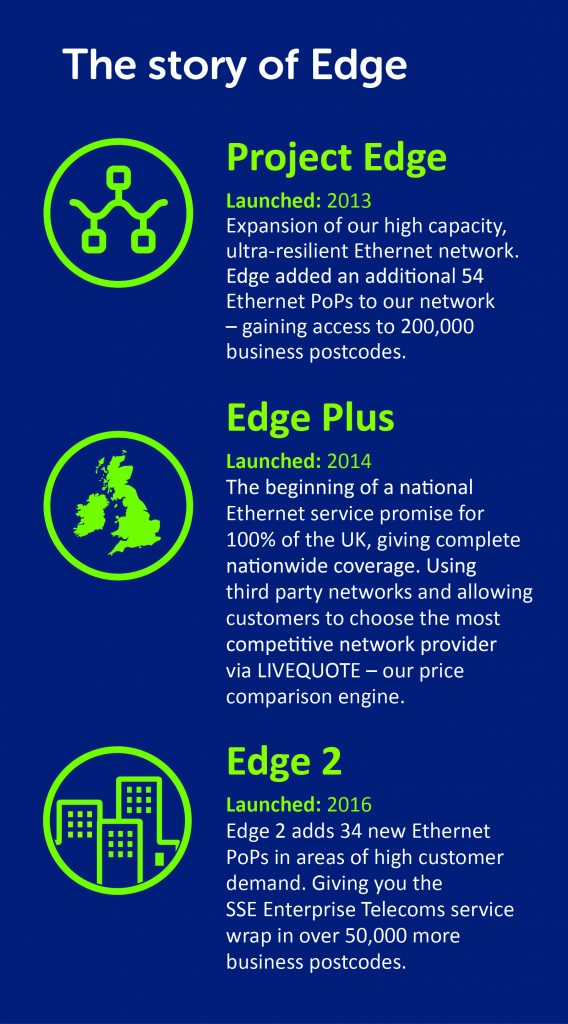
We’re proud to announce that with the launch of Edge 2, our award-winning, high-capacity Ethernet service has increased its coverage of business postcodes by 30%! That means more for your customers and more for you.

In a phased delivery from Q2 2016, we’re adding 34 new Ethernet Points of Presence (PoPs) in areas of high customer demand across the country, like Cheltenham, Bolton, Darlington and Glasgow – reaching a further 58,342 business postcodes. In total Project Edge will now connect over 250,000 postcodes to our state of the art network, improving our service for end users and enhancing the service you provide for your customers.

Give your customers the Edge over their Ethernet competition

We’re retaining all of the flexibility of Edge Plus, but Edge 2 customers will enjoy more coverage, competitive pricing and an even more outstanding service. In fact enterprises in exchange areas will get the best value solution in the UK. And our new PoPs can be found exactly where they’re needed most. Their locations are totally driven by customer demand.

Our network is engineered to the standards of our power stations. Our numerous exchanges are built using the toughest kit available; if a component fails, another is ready to take over. And for extra peace of mind our network is monitored and maintained 24/7, every single day of the year.

This all adds up to the most robust, reliable and cost-effective solution in the UK. And with our user-friendly LIVEQUOTE tool, transition is simple.

SSE1124_edge2_storyofedge

LIVEQUOTE is your starting point

Once the new PoPs are live, LIVEQUOTE will give you the best available price. It’s also where you’ll find an up-to-date schedule for Edge 2 delivery. You’ll be able to track Edge 2 orders immediately, this allows you to respond quickly to your clients’ needs; which ultimately means more business wins.

As a service provider, your proposition has just got a whole lot stronger… and with our ongoing commitment to investment it’ll keep getting better.

We’d love to tell you more about how Edge 2 can help you and your customers. Why not request a callback?

Not sure how LIVEQUOTE will help you? Find out here


Discover our network reach

We can connect you anywhere in the UK

Check your connectivity

What makes a company a GREAT company to work with?

In an industry that has suffered a terrible reputation for its poor customer service stories, with the UK Customer Satisfaction Index reporting a quarter of Telco organisations failed to meeting expectations, Neos Networks strives to be different and buck that trend.

A business is only as strong as its team; that’s why we have taken great care and consideration in hiring the best people to represent Neos Networks to its fullest. By hiring experts from within the telecoms field, especially for our sales team, our customers have a knowledgeable point of contact in the company who knows and more importantly understands the benefits of our products and services.

We believe in the personal touch – from the start of your solution enquiry to the contract signing and beyond, you’ll have one dedicated point of contact that will get to know your company. When someone understands your company, knows how it works, what’s needed and your strategy and plans for the future, we can build a partnership that will support and help you grow as you achieve your goals.

Rob Derbyshire, Operations Manager at Marston’s Telecoms spoke highly of having a single point of contact throughout the quoting, solution-building and purchasing process with us. Even as the solution progressed and different teams were getting involved with the network implementation, Rob continued to be updated by his dedicated account director.

He commented, “The solution was rapidly deployed and Marston’s Telecoms was able to call upon its own dedicated account manager and single point of contact throughout the whole deployment process.” So impressed by Neos Networks’ attitude, Derbyshire has named us as their ‘preferred partner of choice’ for all of their ongoing optical network solutions and Ethernet requirements.

Though we have market clout as being a part of the SSE group – a FTSE32 company with a turnover of £30 billion – Neos Networks enjoys a much lighter and more agile team in comparison to other telecoms giants; we also have the backing of investment of over £4billion from the SSE group. We are able to provide quick network deployment and implementation so customers have new network expansions live far sooner than our peers.

HighNet – a Scottish ISP – has enjoyed 17 per cent growth since first starting its partnership with Neos Networks in 2011 and it continues to delight its customer with its continual high level of customer service today; Neos Networks first helped HighNet to build a private national infrastructure delivering resilient and scalable solutions including connectivity, and disaster recovery services to enterprises across the UK.  With the demand on their newly expanded network increasing at a far quicker rate than expected, they needed to upgrade their service and turned to Neos Networks to once again help them deliver and succeed.

With our agility, flexibility and proven track record of delivering ahead of time, HighNet turned to us again with new requirements; upgrading its core network to 10Gb to meet increased customer demand.

David Alldritt, Technology and Innovation Director at HighNet is exceedingly pleased with the Neos Networks team and its support with HighNet’s recent network upgrade; “The new solution was rapidly provisioned by Neos Networks’ highly skilled and experienced team, who provided a significant amount of support right from the initial deployment stage to the present day. HighNet has benefited from working with the same team from day one and the strong partnership between the two companies has been instrumental in building HighNet’s network from the ground-up.”

Alldritt continued: “Everyone from our account director to the network architect involved in the original deployment is still on-board, which is something of a rarity in the telecoms business!  Not only does this make working together an easier and more enjoyable process, it also ensures that everyone fully understands our business and so are well placed to help us meet our future objectives.”

We love hearing such positive feedback from our customers; it’s what we aim to achieve with all our customers from big national enterprises to small ISPs. We want to give each customer a dedicated approach so we fully understand your needs so we can add value to your network design and help you grow and succeed as your trusted partner.

Jo Cook, Sales Director at Neos Networks, has been instrumental in building a value add sales team, commenting; “To hear such positive feedback from our customers is a fantastic endorsement of the work carried out by the team. It’s great to receive a positive reaction to not just those working on the front line but the whole way through to our solution and provisioning teams as well. We have always strived to set ourselves apart and it’s great to see it being recognised.”

Our customers are part of our team – their accomplishments are our accomplishments and we always want to help people succeed.

If you’d like to receive the same high quality service as our satisfied customers enjoy, request a call back with one of our expert team members today or email [email protected]

You might also like

  • Article

Why NPS scores matter in the telecoms industry

  • Business General
  • Customer Story

Marston’s Telecoms and its core optical network

  • Service Providers
  • Customer Story

HighNet and converged voice and data services

  • Service Providers

Discover our network reach

We can connect you anywhere in the UK

Check your connectivity

Choosing a Data Centre for your business

“There’s more to choosing a data centre than it’s tiering”

It’s easy to become blinded by the tiering claimed by data centre operators, and ignoring the quality of the operations. The latest high-spec equipment can become unreliable if it’s not tested and maintained regularly” said Chris, speaking to an audience of cloud service providers and resellers at the Convergence Summit on 4th October.

Nearly every data centre failure can be traced back to human error rather than design or hardware problems. Individual components are bound to fail sooner or later, and data centre designs take this into account. It’s inattention to detail and ‘finger trouble’ associated with lack of training that brings data centres down.”

Flexibility

Continuing his theme about what makes for a successful partnership between data centre operator and customer, Chris added, “Flexibility is what differentiates a great relationship: a growing service provider doesn’t just need their first rack, they need to know that their data centre provider will help them grow and accommodate them flexibly.”


Nearly every data centre failure can be traced back to human error rather than design or hardware problems.

Chris Jagusz, Managing Director, Neos Networks

You might also like

  • Article

What is 400G optical networking?

  • Optical
  • Article

What is backhaul in networking?

  • Ethernet

Discover our network reach

We can connect you anywhere in the UK

Check your connectivity