



- Optical vs Ethernet: choose your layer first
- Optical Wavelengths vs Spectrum vs MOFN vs Dark Fibre: key differences
- Choosing the right optical connectivity
- Which optical connectivity is right for your organisation?
Optical vs Ethernet: choose your layer first
If you're evaluating high capacity connectivity for DCI, backbone networks or AI infrastructure, first decide whether you need a Layer 2 service, such as Business Ethernet, or a Layer 1 optical service. The choice affects how capacity is delivered, managed and scaled.
Ethernet connectivity – Layer 2
As a Layer 2 service, Business Ethernet carries frames across a provider network and is delivered on a standard Ethernet interface. It’s ideal for managed connectivity between sites, campuses and wide area networks. Or you can extend your network with an Ethernet NNI, with capacities up to 100Gbps.
Optical connectivity – Layer 1
In contrast, optical connectivity services, like Optical Wavelengths, are Layer 1 optical transport. They deliver dedicated optical channels over fibre for high capacity DCI, backbone networks and other optical transport applications, typically from 100Gbps to 400Gbps.
Learn more about Optical networks vs Ethernet
So, if optical connectivity is what you need, which optical solution best fits your business case?
Optical Wavelengths vs Spectrum vs MOFN vs Dark Fibre: key differences
Optical Wavelengths, Spectrum, MOFNs and Dark Fibre can all deliver high capacity connectivity. What differs is how capacity is deployed and scaled, who controls the optical layer, and how operational responsibility is divided between customer and provider:
- Optical Wavelengths: A fully managed Layer 1 service delivered as dedicated wavelengths over a provider-managed DWDM network, typically at fixed capacities such as 10Gbps, 100Gbps or 400Gbps. Best when you want high capacity connectivity without managing the optical layer. Learn more about Optical Wavelengths
- Spectrum: A defined allocation of optical spectrum on a provider-managed DWDM network, allowing you to scale capacity within that allocation. Best when you need more control over capacity than a fixed-capacity wavelength service, without operating the full optical line system yourself. Learn more about Spectrum
- MOFN: A dedicated optical network designed around your routes, topology, resilience requirements and capacity growth plans. Best when you need dedicated optical infrastructure without taking on Dark Fibre-style operational responsibility. Learn more about MOFN
- Dark Fibre: Dedicated unlit fibre that you light using your own optical equipment. Best when you want maximum control over capacity, technology and upgrade paths, and have the expertise to operate the optical layer. Learn more about Dark Fibre
Optical Wavelengths vs Spectrum vs MOFN vs Dark Fibre
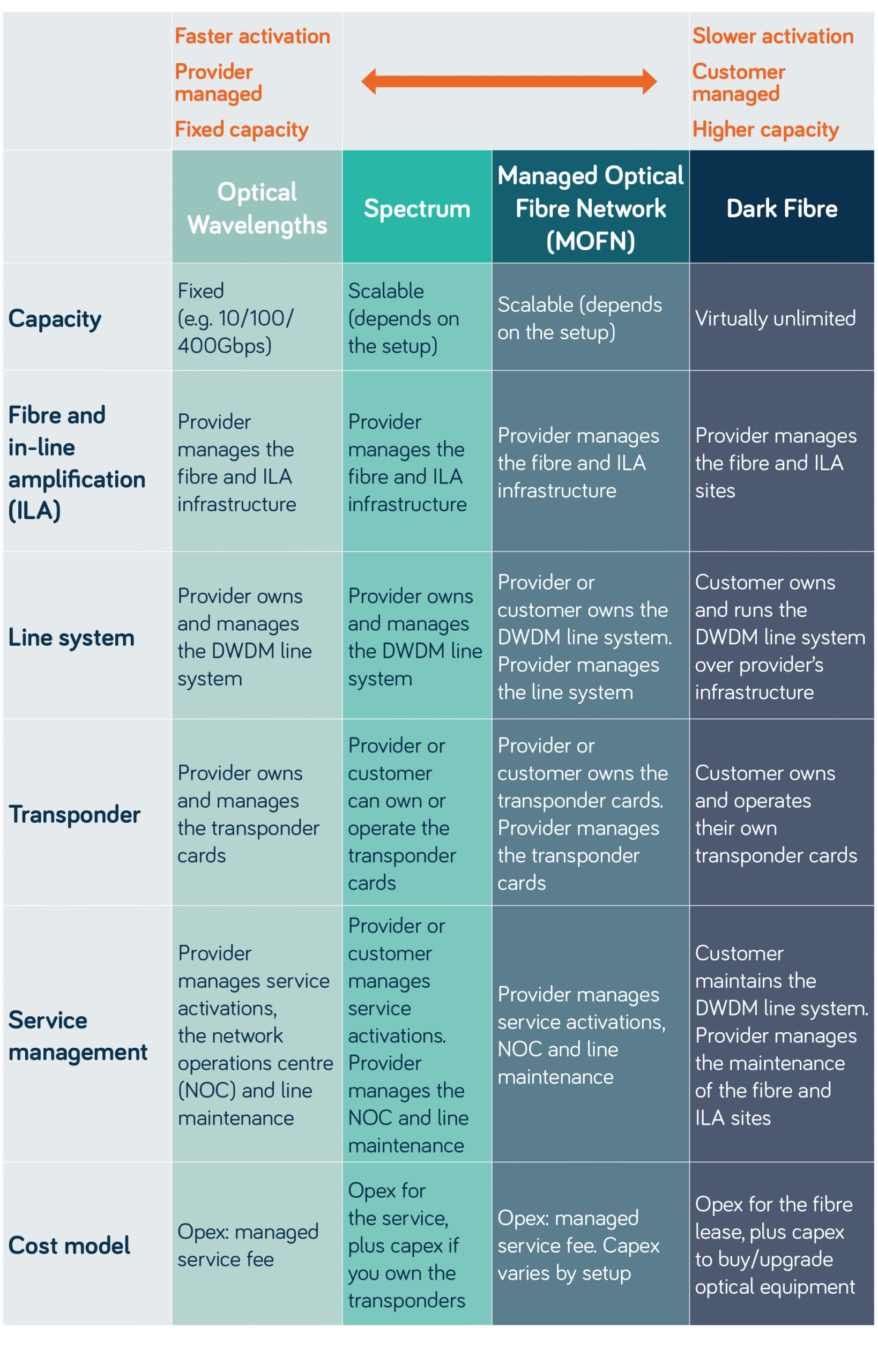
In short, Optical Wavelengths provides fixed-capacity connectivity in a fully managed model, while Dark Fibre gives you maximum control over network design, capacity and technology choices. Wavelength services are typically fast to activate as capacity and routes are pre-built, ready to implement additional services.
Spectrum and MOFN sit between Optical Wavelengths and Dark Fibre, offering more flexibility and scalability than a wavelength service without the operational responsibility of Dark Fibre.
Choosing the right optical connectivity
Choosing between Optical Wavelengths, Spectrum, MOFN and Dark Fibre comes down to how much control, scalability and operational responsibility you need. Here are some questions to consider.
Capacity and scalability
How much bandwidth do you need today and in the long term? Will you scale by ordering more services or by growing capacity within infrastructure you control?
Latency and performance
How latency-sensitive are your workloads? Are provider SLAs enough, or do you need to optimise routes, diversity and resilience yourself?
Control and flexibility
Do you want to choose your own optical hardware, vendors and upgrade cycles? Or would you rather your provider manage them for you?
In-house expertise
Do you have engineers who can design, run and maintain a DWDM line system? Are you prepared to build or buy that capability as a service?
Cost: capex vs opex
Does your business case favour predictable opex or long-term capex investment? Are you ready to fund equipment upgrades or leave it to your provider?
Security and compliance
Do your data sovereignty or compliance requirements demand dedicated infrastructure? Do you need to control encryption?
Time to deploy
How quickly do you need services live on each route? Would a managed option (Optical Wavelengths, Spectrum or MOFN) get you live faster than a Dark Fibre deployment?
Your answers to these questions will point you towards one optical connectivity solution, or a combination of services. Which is right for your organisation?
Which optical connectivity is right for your organisation?
The right choice comes down to how much control, scalability and operational responsibility you need. Choose:
- Optical Wavelengths if you need high capacity DCI or backbone connectivity in a fully managed service model.
- Spectrum if you want to scale capacity within your own spectrum allocation without running the full optical line system.
- A MOFN if you need dedicated optical infrastructure built around your routes and growth plans, delivered as a managed service.
- Dark Fibre if you want maximum control and near-limitless capacity and have the expertise in-house to operate the optical layer yourself.
At Neos Networks, we can deliver high capacity, low latency optical connectivity for your business across our B2B-only, UK-wide fibre network, built to support UK Critical National Infrastructure.
Whether you're scaling DCI, expanding a backbone network or building AI infrastructure, our pre-sales team will help you find the right fit. For more details, download our network map or get in touch.