



What does “spectrum” mean in optical networking?
In optical networking, spectrum refers to the range of light frequencies (or optical wavelengths) used to carry data over fibre cables. These wavelengths sit within specific optical bands, most commonly the C-band (1530-1565nm) and L-band (1565-1625nm).
Telecom providers use technologies like Dense Wavelength Division Multiplexing (DWDM) to divide this optical spectrum into multiple channels. As a result, several data streams can run over a single fibre simultaneously, significantly boosting capacity and efficiency.
With Spectrum as a service, you’re allocated a defined portion of this optical spectrum on the provider’s network. The underlying optical infrastructure is managed for you, while you retain control over how capacity is used. This delivers many of the high performance and scalability benefits of MOFNs and Dark Fibre, without the costs or operational complexities associated with those options.
How do Spectrum services work?
Spectrum is typically delivered as a point-to-point service, making it ideal for high capacity data centre interconnect (DCI) or core networks. It gives you access to a defined slice of the optical spectrum, rather than a single wavelength or an entire Dark Fibre route. For example, you might be allocated 75GHz or 200GHz, which you can divide into multiple DWDM channels as needed.
Fixed grid or flex grid
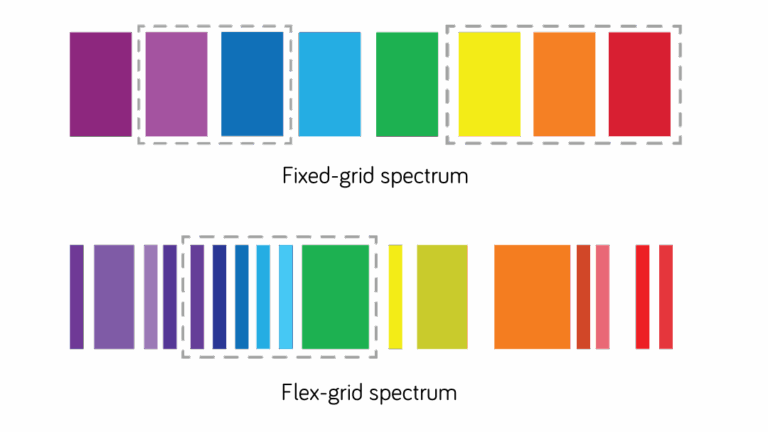
Spectrum may be delivered using fixed grid or flexible grid (flex grid) technology, sometimes referred to as gridless. Flex grid supports variable channel widths, which can allow more efficient use of the available spectrum.
Fixed-grid vs flex-grid spectrum
Division of responsibility
The provider delivers a clean spectrum path between two locations and manages the underlying optical line system. That includes the fibre, in-line amplification and ROADM nodes along the route.
Depending on the service model, you or your provider may own and operate the transponders that light the fibre at each end. Either way, Spectrum gives you control over how capacity is deployed without the need to run a full optical line system over Dark Fibre.
Positioned between managed Optical Wavelength services on the one hand and MOFNs and Dark Fibre on the other, Spectrum is ideal if you need more control than a wavelength service but aren’t ready for a MOFN or Dark Fibre.
How does Spectrum differ from Optical Wavelength services and Dark Fibre?
Spectrum offers a different balance of capacity, control and operational responsibility compared with Optical Wavelengths and Dark Fibre. A fourth option, a Managed Optical Fibre Network (MOFN), also sits within this range of optical services.
Here’s how Neos Networks’ optical services compare:
- Optical Wavelength services: A fully managed service with a fixed capacity (e.g. 10Gbps, 100Gbps or 400Gbps) delivered by the provider. The provider owns and manages the optical line system and transponders, so you simply connect and use the service.
- Spectrum services: You lease a block of optical spectrum, for example 75GHz, delivered over the provider’s DWDM line system. While the provider manages the fibre and line system, you or the provider may own and operate the transponders. This gives you more control and scalability than a wavelength service without the complexity of running a full optical line system over Dark Fibre.
- MOFN: The provider designs, operates and manages a dedicated optical network over their fibre infrastructure. Either you or the provider owns the DWDM line system and transponders, depending on the setup. You scale capacity by changing the optical network design, giving you more flexibility than Spectrum but less operational responsibility than Dark Fibre. It’s like having your own private DWDM network, without the operational complexities and responsibilities.
- Dark Fibre: You lease a pair of unused fibres and provide and operate the DWDM line system and transponders used to light them. This gives you maximum control and near-limitless scalability, but full responsibility for your network operations.
What are the benefits of Spectrum?
Spectrum combines high capacity, flexibility and control. Here are the main benefits for your business.
Flexible bandwidth growth
Scale capacity by adding or upgrading wavelengths within your allocated spectrum. No need to order additional services as demand increases.
Control without Dark Fibre overhead
Gain greater design control and vendor-agnostic options than with Optical Wavelengths, without the costs or complexity of Dark Fibre. Align optical hardware choices and upgrade cycles with your wider network strategy.
Rapid deployment using existing infrastructure
Activate high capacity services faster than with a new Dark Fibre build, using pre‑deployed fibre and optical line systems. Reduce time to service on critical routes.
Resilience and route diversity
Design optical-layer diversity within the Spectrum service, rather than relying on fixed protection models. You can work with the service provider to predefine physical routes during the setup phase.
Is Spectrum right for your business?
Spectrum is a good option if you need high capacity optical connectivity with more control at the optical layer than traditional managed services. With the right in-house expertise, you can make full use of your allocated spectrum to scale fast, without the cost and complexity of Dark Fibre.
Here are some examples of Spectrum use cases.
| Industry/sector | Example use case |
| Hyperscalers and cloud providers | Run multiple 100Gbps or 400Gbps channels across your backbone using your own equipment and network architecture. |
| Telcos and wholesale service providers | Provision new high capacity connectivity for your customers without relying on wavelength services or operating Dark Fibre. |
| Large enterprises and financial services | Connect business sites and data centres with more control at the optical layer than with fully managed services. |
| Broadcast and media companies | Manage high‑bandwidth links to transport large video files or live content nationwide with consistently low latency. |
| Research and education | Support advanced research applications that demand scalable, high capacity connectivity with predictable performance. |
| Public sector organisations | Scale up public service links to meet growing digital demands more cost-effectively than with Dark Fibre. |
In short, Spectrum is a good fit if you want to design and scale high capacity optical connectivity yourself without leasing Dark Fibre.
Neos Networks Spectrum solutions
At Neos Networks, we specialise in delivering high capacity optical connectivity across the UK, including Optical Wavelengths, Spectrum, MOFN and Dark Fibre. Extend your reach with our B2B-only, UK-wide network.
If you’re a hyperscaler or large enterprise looking for high capacity connectivity you can scale fast, get in touch. Our pre-sales team will help you choose the right optical links for your organisation.
Spectrum FAQs
-
Is Spectrum the same as Dark Fibre?
No. With Dark Fibre, you lease unused fibre and install and operate all the optical equipment yourself. With Spectrum, you lease a defined block of optical spectrum on a provider‑managed DWDM network, so you get more control than a wavelength service without running the fibre or line system.
-
Where is Spectrum available in the UK?
Spectrum is available on fibre routes where providers operate DWDM‑enabled optical line systems, typically across national backbone and major regional networks. At Neos Networks, we operate one of the UK’s largest, business‑only fibre networks, with extensive national, regional and metro fibre routes.
Download our network map to check availability at your locations.
-
Do you need in‑house optical expertise to use Spectrum services?
You don’t need in‑house expertise to run the fibre or DWDM line system because they’re managed by your provider. However, if you choose to own and operate your own transponders, you’ll need the appropriate optical skills to manage that equipment.
-
How much bandwidth does Spectrum support?
Spectrum supports very high bandwidth, from multiple 100Gbps channels up to terabit-scale capacity, depending on your spectrum allocation and how you configure it. You can scale capacity by adding or upgrading wavelengths within your spectrum, rather than ordering new services or installing new fibre.
-
Is Spectrum more cost-effective than wavelength services?
Spectrum can be more cost‑effective than wavelength services at higher bandwidths because you scale capacity within a single spectrum allocation instead of paying for multiple fixed‑rate wavelengths. At lower capacities, a managed wavelength service is often simpler and cheaper. Whether it’s cheaper depends on how much bandwidth you need and how fast you plan to scale.
-
How quickly can Spectrum services be deployed in the UK?
Spectrum can be delivered in around 30 days – often faster than Optical Wavelengths – because it uses existing DWDM‑enabled fibre and optical line systems. Deployment times depend on route availability and site readiness.
Download our network map to check availability at your locations.