



Build your high capacity network aross the UK with Dark Fibre
What is Dark Fibre?
Dark Fibre, also known as “unlit fibre”, is fibre optic cable that is installed but not in use. It’s called “dark” because it has no light signal passing through it. Network owners lease these unused fibres to organisations so they can build their own private network.
With provider-managed optical services (also known as “lit fibre”), the network operator supplies and manages the optical equipment for you. You get a “plug-and-play” service with a set bandwidth and performance. With Dark Fibre, you lease only the fibre. You install your own equipment at each end and control how the link operates. And you choose the technology, bandwidth and performance level your organisation needs.
So Dark Fibre gives you maximum control and flexibility to design a high capacity network with almost limitless scalability.
Learn more about Dark Fibre vs Lit Fibre
How does Dark Fibre work?
Dark Fibre is unused fibre optic cabling with no data transmission equipment attached. So it’s a physical path, not a service.
Fibre cables contain multiple strands. You lease a specific strand or multiple strands between two fixed network points, such as offices, data centres or network nodes.
Fibre optic cable
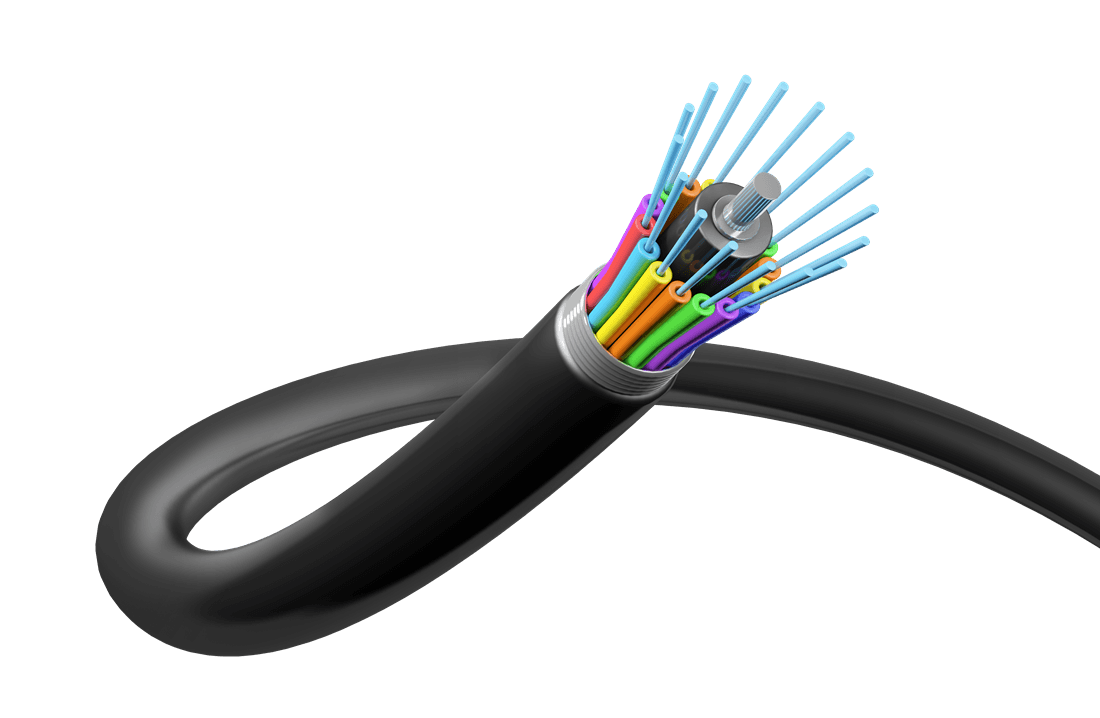
You then install the optical equipment needed to “light” the fibre. That equipment generates the light signals that carry your data.
As it’s your dedicated line, you choose the protocol, data rate, modulation and equipment configuration. Capacity, latency, encryption and overall performance all depend on the equipment you deploy, not provider presets. And with technologies like Dense Wavelength Division Multiplexing (DWDM), you can increase the capacity by running multiple wavelengths on the same strand.
In other words, the provider manages the physical layer: fibre cables, ducts and the physical route. You handle network monitoring, troubleshooting, upgrades and optical power levels.
What are the benefits of Dark Fibre?
The main advantage of Dark Fibre is that you have complete control over your network. Here are the key benefits.
Customisation
Choose your own networking equipment, protocols and specifications to suit your business needs. For example, you can use DWDM to increase the number of channels per fibre.
Scalability
As Dark Fibre is unused optical fibre, it offers almost limitless capacity. You can scale up your bandwidth as your business grows by simply updating the optical hardware.
Low latency
You have exclusive access to your fibre strand, so you’re not competing with others for bandwidth. By choosing the right equipment and network design, you can create low or ultra-low latency connections.
Security
Dark Fibre gives you a private physical connection that isn’t shared with other organisations. You can add your own encryption to meet specific operational or regulatory requirements.
Reliability
You design the network, so you can build in resilience with diverse paths or redundant equipment. And when faults occur, you can diagnose and resolve them immediately without waiting for a provider to troubleshoot.
Cost efficiency
Dark Fibre requires more upfront investment than fully managed optical services. But it can be more cost-effective if you have heavy, long-term data demands because you control usage and upgrades.
However, Dark Fibre has its challenges, and you’ll need to weigh them carefully before taking the plunge.
Dark Fibre challenges
Here’s what to bear in mind if you’re considering Dark Fibre:
- Upfront capital cost: You need to buy and install all the active optical equipment, such as high capacity transceivers and DWDM systems. Are you ready for this high initial capex?
- Specialist skills: Running a Dark Fibre network requires significant expertise to select install hardware and manage the network. Do you have the right expertise in-house?
- Operational responsibility: With Dark Fibre, you operate the entire active layer, including network monitoring, maintenance, troubleshooting and hardware upgrades. Do you have the necessary resources?
- Route availability: If Dark Fibre isn’t available on an existing route, you’ll need to build, which adds time and cost. Is Dark Fibre available for your planned routes?
- Resilience strategy: You’ll need to design and implement your own resilience measures, such as diverse routing, failover mechanisms and redundant hardware.
So Dark Fibre gives you unrivalled control, which is ideal for certain use cases. But it’s not the right solution for everyone.
Who is Dark Fibre suitable for?
Dark Fibre can work well if you need secure, high capacity, low latency connectivity and want full control over network performance and design.
Here are some examples of how Dark Fibre is used today.
| Industry/sector | Example use case |
| Hyperscalers and cloud providers | High capacity data centre interconnects (DCI) to transfer large volumes of traffic across core networks and cloud regions |
| Network service providers | ISPs using Dark Fibre for new access, backhaul or metro routes, and carriers expanding reach or adding specialised optical services |
| Government and public sector | NHS trusts handling large volumes of clinical images and patient data, and government bodies delivering public services |
| Financial services | Banks and trading firms requiring low latency links for real-time trading and private, deterministic site-to-site connectivity |
| Large enterprises | High capacity links between sites, supporting data replication, private cloud, AI and IoT |
| Broadcast and media | Real-time transfer of uncompressed 4K content between studios, production facilities and data centres |
| Research and education | Research centres running data-heavy workloads and universities transferring data between labs and high-performance computing clusters |
How much does Dark Fibre cost in the UK?
The total cost of Dark Fibre varies widely depending on the provider, location, route availability and the optical equipment you need for your network.
First, leasing strands on-net, where fibre already exists, is far cheaper than commissioning off-net build work. And if you need to build off-net, costs may vary significantly between urban, suburban and rural areas because civil works and permissions are major cost drivers.
Second, you need to buy your own optical equipment, such as transceivers, DWDM systems, amplifiers and related hardware. High capacity DWDM can significantly increase your upfront capex.
Third, you need to factor in the staff costs of deploying and running the network. With Dark Fibre, you manage network monitoring, maintenance, troubleshooting and upgrades, which all adds to ongoing operational costs.
Fourth, Dark Fibre attracts business rates, also known as “fibre tax”, but only once the fibre is lit. These annual charges, levied by local authorities per connection, add to your ongoing network costs.
Finally, the contract type matters. An IRU (Indefeasible Right of Use) is a long‑term right to use specific fibre pairs, bought upfront as a one‑off capital purchase. That means higher initial capex but lower annualised costs. In contrast, an annual lease cuts the upfront spend but can cost more across the term due to recurring annual charges.
Given these factors, is Dark Fibre worth the investment for your organisation?
Is Dark Fibre worth it?
Dark Fibre can make financial sense if you need total control over your network, your bandwidth and your budget.
Consider Dark Fibre if you:
| ✓ | Expect significant long-term bandwidth growth: Scaling Dark Fibre via equipment upgrades can be more cost-efficient than buying increasingly high capacity lit services. |
| ✓ | Need predictable low latency: You get full control to minimise latency for real-time applications like data centre interconnects, financial trading, AI and IIoT. |
| ✓ | Have in-house optical expertise: Without the skills to deploy and maintain your network, the operational burden can outweigh the benefits. |
| ✓ | Need a private, isolated network: You can apply your own encryption to meet security and compliance needs in regulated industries such as healthcare and finance. |
| ✓ | Can make maximum use of the fibre: The more capacity you use, the lower the cost per bit over time. |
| ✓ | Have key sites already on-net: If most of your routes are off-net, the build costs could be significantly higher. |
To assess the business case for Dark Fibre, you’ll need to:
- Estimate long-term bandwidth and latency requirements.
- Evaluate your internal capability to run the network.
- Consider any industry-specific privacy and security measures for compliance.
- Check whether key sites are on-net with your chosen provider.
If you think you’ve got a case for Dark Fibre, the next step is availability. Where can you get it?
Where is Dark Fibre available in the UK?
Dark Fibre is generally available across national backbone and regional backhaul networks, but coverage depends on where there are spare fibre strands.
Spare fibre exists across the UK. The London area, Manchester and other major urban corridors have the largest Dark Fibre footprints because they have long-established fibre networks and high capacity demand.
However, availability varies by provider. Some operators have large national networks with many routes on-net. Others rely mainly on third-party tails or new build work to extend their reach.
At Neos Networks, we operate one of the UK’s largest, business-only fibre networks, with extensive national, regional and metro Dark Fibre routes.
Dark Fibre solutions for your business
If you’re looking for a UK Dark Fibre solution, we can help. With our UK-wide network and wide range of third-party tails, we specialise in serving hard-to-reach areas. Download our network map to check our nationwide reach.
Our experts work with you to map the optimal route, overcome challenges and plan for growth. Whether you need a flexible, short-term lease or a 25-year IRU, we design the best solution for you and your budget.
Build your high capacity network aross the UK with Dark Fibre
Want to talk to one of our Dark Fibre experts? Get in touch. We’ll be happy to make Dark Fibre work for your organisation.
Dark Fibre: FAQs
-
Who owns Dark Fibre?
Dark Fibre can be owned by telecom providers, ISPs or large enterprises that have built their own fibre infrastructure. Typically, network operators own the fibre and lease unused strands to businesses so they can build and run private optical networks.
-
How does Dark Fibre differ from lit fibre services?
Dark Fibre is unused fibre optic cable that you lease or buy and then light with your own equipment to create a private network. In contrast, lit fibre refers to fibre optic cable carrying a managed service such as Optical Wavelengths or Business Ethernet, with the network provider responsible for operating and maintaining the service.
-
Is Dark Fibre the same as a leased line?
No. Unlike Dark Fibre, a leased line is a managed service, often delivered as Dedicated Internet Access (DIA), where the provider supplies the equipment, defines the bandwidth and manages the connection end to end. At Neos Networks, we offer both “wires only” and managed DIA services with scalable bandwidth from 10Mbps to 10Gbps.
-
Can Dark Fibre connect multiple sites, or only single point‑to‑point routes?
Dark Fibre is typically delivered as point‑to‑point links between locations. However, you can combine these links to build more complex topologies. Because you design and manage the network, you can create ring, mesh or hub‑and‑spoke architectures to connect multiple sites.
-
How fast is Dark Fibre?
Speeds on Dark Fibre are only limited by the equipment you deploy and the capability of the fibre. In practice, this can range from around 1Gbps to hundreds of gigabits or even terabit-scale capacity, depending on your network design.
-
What are the advantages of using Dark Fibre?
Dark Fibre gives you full control over how your network is designed, operated and scaled. You define routing, capacity and security. It also provides effectively unlimited capacity, so you can increase bandwidth over time without changing the underlying infrastructure.
-
What challenges does a Dark Fibre rollout present?
Dark Fibre gives you more control, but that comes with greater responsibility. You’ll need the right expertise and equipment in place, and deployment timelines can vary depending on route complexity, civil works and wayleave agreements. Dark Fibre also involves greater upfront investment and some additional ongoing costs, such as business rates (fibre tax).
-
Who typically uses Dark Fibre?
Dark Fibre is most commonly used by hyperscalers, network operators, wholesale providers and large enterprises that need full control over their connectivity. However, it can suit organisations of any size with specialist networking, compliance or performance requirements.