Regional disparities, opportunities
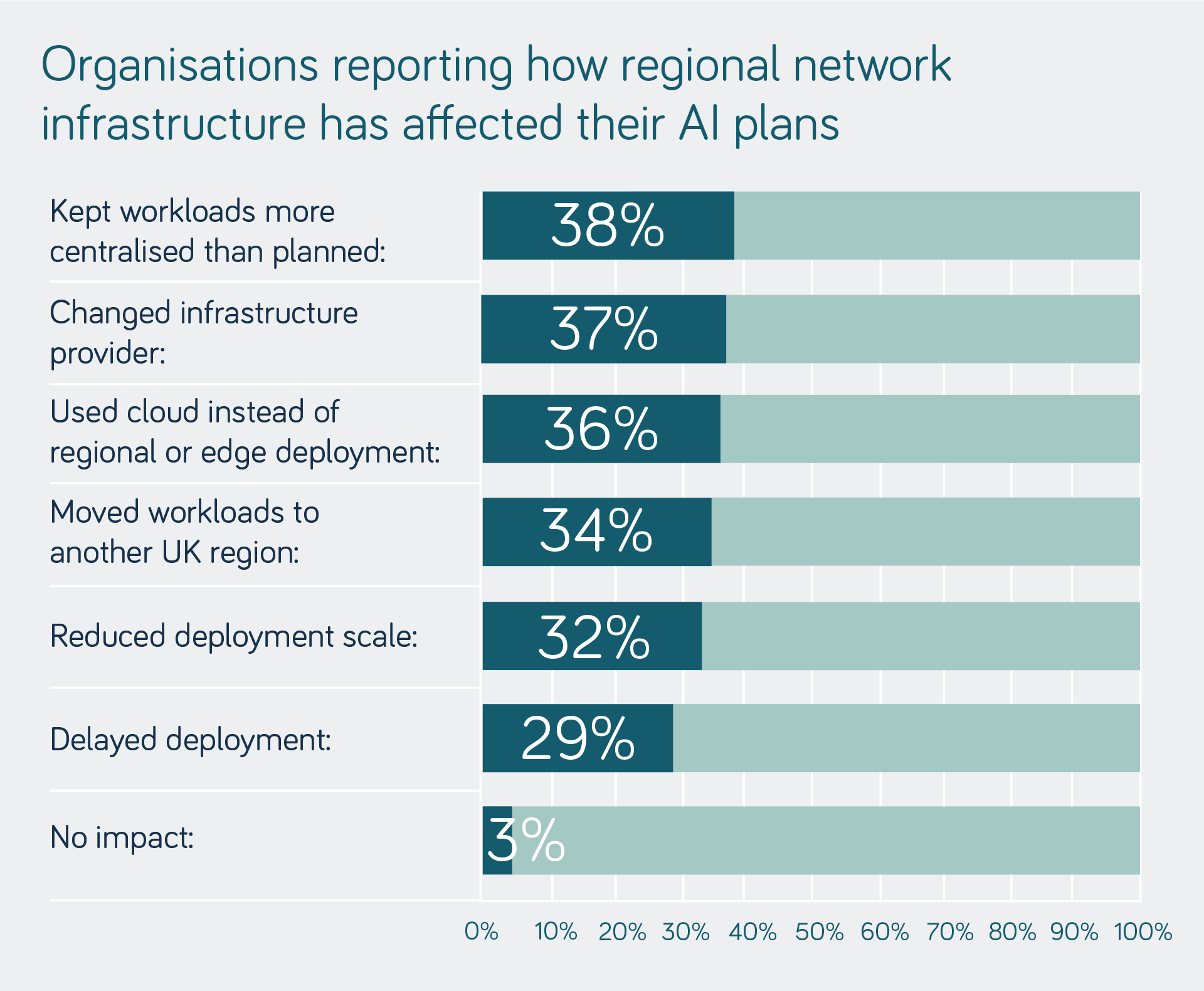
Can local infrastructure support AI where enterprises need it? Or does it force workloads to be centralised, relocated, reduced or delayed? A digital divide is emerging between regions that can and can’t support AI at scale.
While our survey highlighted regional disparities, it also suggests several regions are set to become AI hubs.
Asked which region is most relevant to their organisation’s AI strategy over the next two to three years, 42% of enterprise respondents naturally picked London. But they also saw opportunities emerging across multiple UK regions (see report for details).
The regional picture also varies by sector. Different industries are likely to drive distinct regional AI growth corridors, reflecting local sector expertise.
End-to-end growth, data sovereignty
As AI use grows nationwide, our service provider research points to how networks will evolve in the regions.
Almost all (96%) see a shift towards inferencing or edge delivery over the next two to three years. But where do they expect AI-driven workloads to generate the greatest traffic growth? Opinions were divided across edge, metro, access, data centre interconnect and core networks (see report for details).
Data sovereignty is another key issue. Nearly all (97%) service providers say that data sovereignty and using local infrastructure are important to customers deploying AI workloads on their networks, with around half saying they’re very important.
In short, service providers are expecting AI to drive end-to-end network growth, while data location and local infrastructure remain critical for many applications.
Regional readiness, national opportunity
With world-class research, rapidly expanding data centres and government-backed AI Growth Zones, the UK has set its sights on becoming an AI superpower.
However, realising that ambition nationwide ultimately depends on the infrastructure connecting it all.
Our research shows large enterprises across sectors see AI opportunities emerging across several UK regions, not just London and the South East.
So regional AI readiness is a national opportunity. But how do we build the connected foundations for regional AI growth?
Download the report for insights on:
- Which UK regions enterprises see as most important to their AI strategies
- How connectivity is influencing enterprise AI deployment decisions across the UK
- How service providers expect AI-driven network capacity to scale in the coming years
- What enterprises and service providers believe is needed to support the next phase of AI growth