



Connect your multisite business for the future with SD-WAN
What is SD-WAN?
SD-WAN (Software-Defined Wide Area Network) is a networking technology that uses software to bring together your sites, cloud platforms and remote users in one secure wide area network (WAN).
With centralised management and real-time visibility, you have full control over how your network performs. Designed to support cloud-first strategies and digital transformation, SD-WAN is ideal for multisite organisations that need secure, high-performance connectivity.
SD-WAN vs traditional WANs
Traditional WANs rely on fixed routing and centralised traffic paths, often over MPLS or IP-VPN.
MPLS
MPLS (Multiprotocol Label Switching) is a common underlay in traditional enterprise WANs. Providing reliable, low latency connectivity with high QoS (quality of service), it’s ideal for real-time applications like voice or video. But MPLS can be expensive and slow to scale across multiple sites.
IP-VPN
IP-VPNs use MPLS to create private, secure connections between sites in traditional WANs. While suitable for businesses with strict security and business needs, IP-VPNs rely on fixed routing, which can limit performance and scalability.
In contrast, SD-WAN allows you to integrate MPLS with other connection types, like internet and LTE/5G, giving you more flexibility and cost efficiency.
Traditional WANs typically backhaul all traffic through a central data centre, creating a potential bottleneck. SD-WAN takes a different approach, using dynamic path selection to route traffic over the best available link, enhancing resilience and user experience.
How does SD-WAN work?
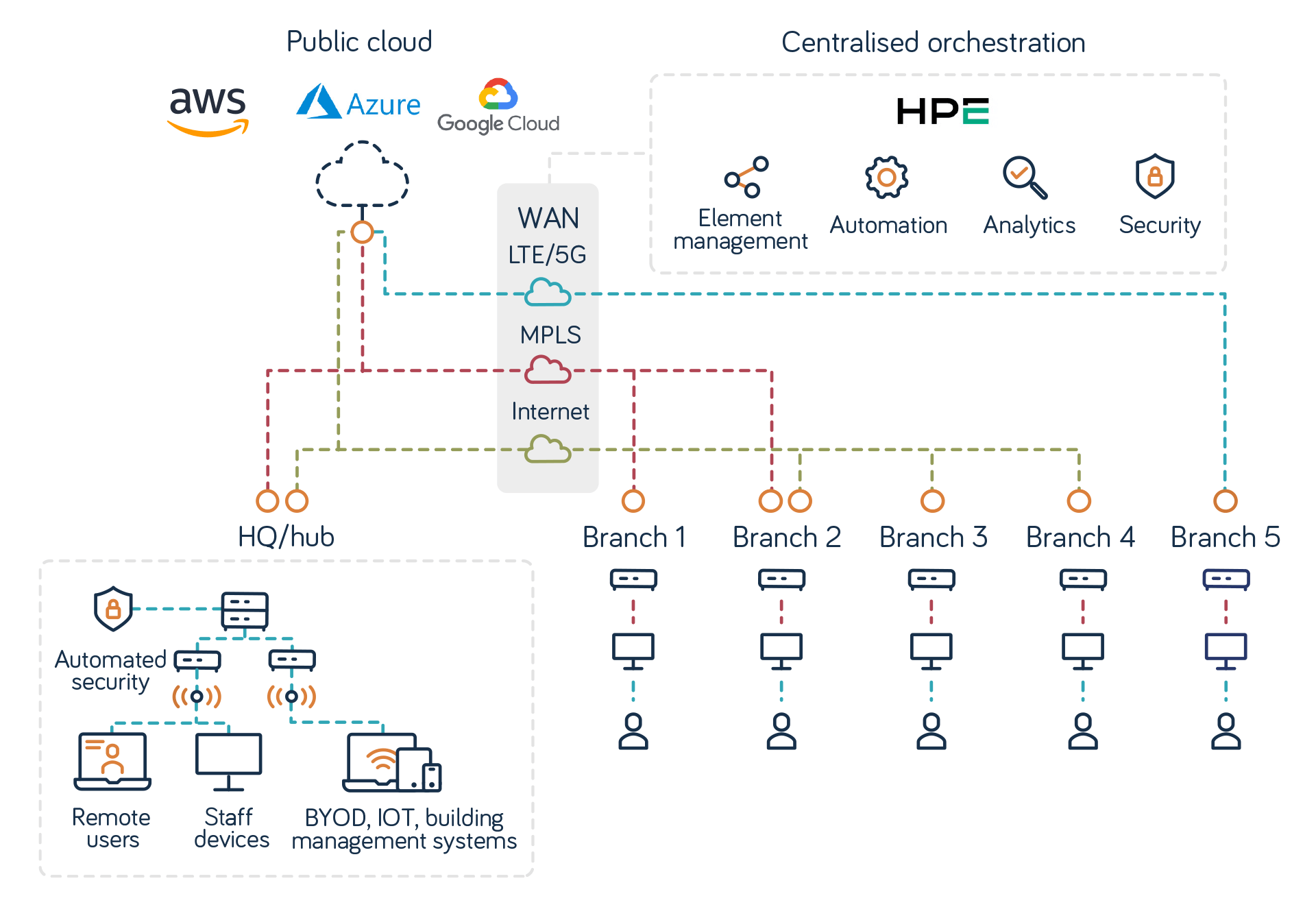
SD-WAN applies Software-Defined Networking (SDN) principles to your wide area network. It creates a virtual overlay across all your connections – MPLS, internet and LTE/5G – enabling intelligent traffic steering instead of static routing.
It continuously monitors network conditions like latency, jitter, packet loss and bandwidth. Using this data, SD-WAN routes traffic dynamically along the best-performing path based on real-time performance and business intent.
Management is centralised through a single dashboard, so you can define and enforce traffic policies across all sites. This ensures business-critical applications like voice, video and SaaS tools are prioritised.
SD-WAN also enables direct access to cloud services at each site, reducing delay and improving efficiency. Security features such as encryption and firewalls are built in and can be extended with SASE for cloud-based protection across your network.
For example, Neos Networks SD-WAN is powered by the next-generation HPE Aruba Networking EdgeConnect platform, enabling centralised orchestration, direct cloud access and automated security.
Neos Networks SD-WAN
What are the benefits of SD-WAN?
SD-WAN delivers a range of benefits that go beyond connectivity:
| Benefit | What it means for your business |
| Centralised control | Manage all sites, users and traffic policies through a single dashboard. |
| Flexibility and scalability | Adapt and grow your network easily, using multiple connection types across all locations. |
| Real-time visibility | Monitor network performance and respond instantly when needed. |
| Dynamic traffic steering | Route traffic over the best path based on live conditions and business needs. |
| Application prioritisation | Prioritise business-critical apps like voice, video and SaaS for peak performance. |
| Cloud performance | Connect sites directly to cloud platforms for faster, more reliable access. |
| Resilience and uptime | Keep teams connected with automatic failover and path conditioning. |
| Automated security | Enforce security policies across your network, with optional SASE integration. |
| Cost efficiency | Route traffic over the most cost-effective connection without compromising quality. |
Who is SD-WAN for?
SD-WAN is ideal if you need secure, high-performance connectivity across multiple sites, cloud platforms and remote users. It’s a smart choice if you want to:
- Modernise your organisation’s legacy WAN
- Roll out cloud-first or SaaS strategies
- Support a distributed or mobile workforce
- Simplify network management and security
It’s especially useful for sectors where uptime, visibility and cloud performance are critical, such as:
- Enterprise and multisite organisations: Manage complex networks with centralised control and consistent performance.
- Financial services: Support trading, payments and data-heavy operations with resilient, secure connectivity.
- Public sector: Deliver scalable, secure networks aligned with the UK government's Cloud First strategy.
- Transport and logistics: Connect offices, stations and depots while supporting mobile teams and remote access.
- Energy and utilities: Interconnect critical infrastructure and distributed operations with full visibility and control.
- Healthcare: Enable secure access to cloud-based records, applications and remote diagnostics across multiple locations.
How does SD-WAN support SaaS and cloud services?
SD-WAN improves SaaS and cloud performance by enabling direct, secure access at each site without backhauling traffic through a central data centre. It’s built for cloud-first strategies, with centralised orchestration and policy control across all sites and users. Here’s how it helps.
Local breakout to cloud services
Sites connect directly to platforms like Microsoft Azure, AWS and Google Cloud, reducing latency and improving user experience.
Avoid backhaul bottlenecks
Routing traffic locally avoids the delays and costs of traditional WAN configurations.
Optimise SaaS performance
SD-WAN allows you to prioritise business-critical apps like Microsoft 365, Salesforce and Zoom, so users get a consistent experience.
Steer traffic dynamically
Real-time monitoring of latency, jitter and packet loss lets SD-WAN route traffic down the best-performing path.
Secure cloud access
Integrated security and optional SASE support protect users and data as they access cloud services from any location.
So is SD-WAN as secure as traditional, MPLS-based WANs?
How secure is SD-WAN?
SD-WAN can be more secure than MPLS if it’s implemented correctly. MPLS uses dedicated connections and is private by design, but it lacks native encryption and relies on separate security layers.
Modern SD-WANs build security into the network architecture:
- Encrypted VPN tunnels (IPsec or SSL) protect data over public networks.
- Next-generation firewalls protect against unauthorised access.
- Zero-trust segmentation limits movement across your network.
- Real-time detection and analytics help identify and respond to threats fast.
- Centralised management enforces policies consistently across all locations and users.
Unlike MPLS, SD-WAN often uses the public internet, so it can present a wider potential attack surface if misconfigured. However, that risk is mitigated by implementing SD-WAN with SASE.
With encryption, firewalls and other protections combined with SASE, SD-WAN is typically more secure than MPLS alone, especially for modern, cloud-first networks.
How does SD-WAN integrate with SASE?
SD-WAN is the foundation of SASE. It provides the connectivity and traffic optimisation while SASE delivers network-wide security.
SD-WAN connects sites, cloud platforms and remote users. SASE layers on security functions like secure web gateway (SWG), zero-trust network access (ZTNA) and cloud access security broker (CASB), which helps protect SaaS and other cloud services.
Together, SD-WAN and SASE ensure security policies apply across all your locations, remote users and cloud apps without complex on-premises hardware. This integration gives you a single, unified framework for secure, reliable connectivity across your entire WAN.
How to choose an SD-WAN provider
Start by understanding your organisation’s needs. Ask yourself:
- How many sites and remote users do you need to connect?
- What weaknesses in your current network do you need to fix?
- Where do you plan to scale and how quickly?
- How important is direct access to cloud and SaaS platforms?
- Which applications are business-critical?
- What level of security and compliance do you require?
- What SASE integration do you need?
Then look for a provider that offers performance, security and flexibility without adding complexity or cost. Here are some key features to look for in a service:
| ✓ | Network reach | Can they connect all your sites, including remote or hard-to-reach locations, with diverse access options? |
| ✓ | Scalability and flexibility | Support for multiple underlay types and the ability to grow with your business |
| ✓ | Performance and reliability | Features like dynamic path control, tunnel bonding and automatic failover to keep critical apps running |
| ✓ | Centralised control | A single dashboard for real-time visibility, easy policy management and reporting |
| ✓ | Cloud and SaaS optimisation | Direct cloud access and prioritisation for tools like Microsoft 365, Zoom and Salesforce |
| ✓ | Integrated security | Edge-to-edge encryption and seamless SASE integration for consistent protection |
| ✓ | Ease of deployment | Zero-touch provisioning and automated updates to simplify rollouts |
| ✓ | SLAs and support | Clear SLAs and 24/7 expert support for guaranteed performance. |
Above all, choose a provider with a proven track record of delivery.
Why Neos Networks for SD-WAN?
If you’re considering SD-WAN for your organisation, we can help. As a UK Critical National Infrastructure (CNI) provider with nationwide reach, we tick all the boxes above and more.
With Neos Networks SD-WAN you get:
- UK-wide, B2B-only network: Built for CNI, forming the backbone of your WAN.
- Flexible connectivity options: Combine Ethernet, Optical, internet and LTE/5G underlays with cloud and SaaS platforms.
- End-to-end management: From circuit design to device management and optimisation, delivered and operated by Neos.
- SASE integration: Works with leading providers like Zscaler, Netskope and Palo Alto Networks for cloud-based security.
- Exceptional service: 24/7 UK-based Network Operations Centre support, dedicated account management and industry-leading NPS.
- Trusted expertise: Over 20 years’ experience connecting UK business-critical networks.
Ready to explore SD-WAN? Get in touch. Our pre-sales team will be happy to design an SD-WAN that meets your business goals.